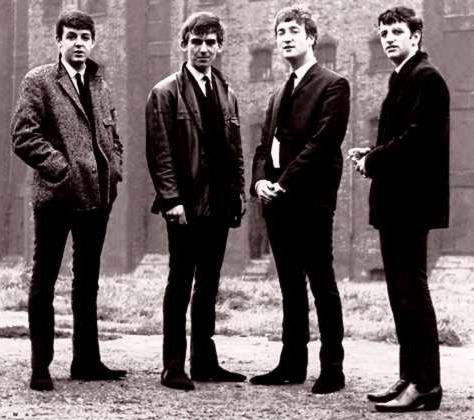
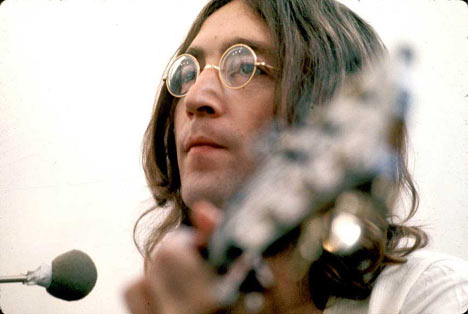
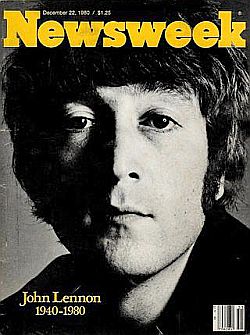
Imagine if a different outcome occurring in front of The Dakota in New York City on December 8, 1980.
What if John Lennon were less accommodating to his fans who regularly waited outside and obtained autographs at the entrance of The Dakota? Would life be different if somebody observed the fat, delusional psychotic -- obsessed with assassinating the former Beatle -- who stalked the building hours after securing the singer's autograph on a couple of Double Fantasy, the last album that Lennon would record?
Try to envision a world in which Lennon lived to see December 9, 1980... and beyond.
Three days ago, the Kennedy Center of the Performing Arts feted Paul McCartney during a ceremony that celebrated the careers of "five extraordinary artists." Singer Merle Haggard. Broadway composer Jerry Herman. Choreographer Bill T. Jones. McCartney. Television producer Oprah Winfrey. If he had lived, 70 year-old John Ono Lennon -- nee John Winston Lennon -- would have made the group six.
Critics will celebrate Lennon's musical career that spanned from a LIverpool ruffian singing "Ain't She Sweet" in working-class cavern, mop-top teen idol donned in collar-less Pierre Cardin suit, drug-fueled solo artist champion of working-class heroes and "Mr. Mom" singer contented with staying at home with his young son. Sociologists will pontificate about Lennon's personification as a rock star "bigger than Jesus", anti-war and peace activist, target of the ire of former President Richard M. Nixon.
Lennon's anti-war protests got him caught in Tricky Dick's cross hairs. The former Beatle and wife Yoko Ono kept company in the early 1970s with Chicago Seven defendants Jerry Rubin and Abby Hoffman, poet John Sinclair, and Black Panther co-founder Bobby Seale. Lennon and Ono co-hosted The Mike Douglas Show in February 1972. Their special guests included a group as diverse as Rubin, Seale and singer Chuck Berry, consumer advocate Ralph Nader, musicians The Chambers Brothers and comedian Louis Nye. Needless to say that occupants of the green room that week did not resemble Douglas' usual roster of visiting guests. Nixon took the sage advice of South Carolina Republican Senator Strom Thurmond. An extremist for the political right, Thurmond penned a memo in February 1972 that advised that "deportation would be a strategic counter-measure" against the former Beatle.
One month later, the United States Immigration and Naturalization Service (INS) commenced deportation proceedings based, in part, on Lennon's 1968 conviction in Great Britain for possession of marijuana. While Ono was granted permanent residency in 1973; on March 23, 1973 the INS gave Lennon 60 days notice to leave the country. Soon, though, larger political issues -- resignation of Vice President Spiro Agnew, Watergate hearings, economic inflation and Nixon's impending departure from the White House -- occupied the President's time. The INS' deportation order was overturned in 1975. Lennon's application for permanent residency was granted a year later.
Lennon became a house husband in 1975 after the birth of his son Sean. While McCartney and his wife Linda Eastman -- never blamed as a spousal source of the group's breakup -- crooned "silly love songs", George Harrison established his own recording (Dark Horse Records) and movie-production (HandMade Films) companies, and Ringo Starr toured with an All-Star band, Lennon changed diapers. In 1980, he and Ono returned to the studio to record what would become his last album, Double Fantasy.
In an Associated Press (AP) interview, widow Yoko Ono offered her impression of Lennon at age 70. She suggested that Lennon would initially have become angry at the idea of reaching his eighth decade. The "smart Beatle" resented turning 40 in 1980 -- a time when people considered 40 as "old". Ono said that if her husband lived to see 70, he would have accepted his what some still characterize as "old age."
A psychopath attempting to impress a Yale coed took Lennon away from us much too soon. More than a few of us would have loved to know Lennon's opinions on Reagonomics, yuppies, reunification of East and West Germany, fall of the Soviet Union, untimely death of Princess Diana, weapons of mass destruction, "war on terror", Napster, YouTube, iTunes and the election of President Barrack Obama.
All we can do is imagine.


